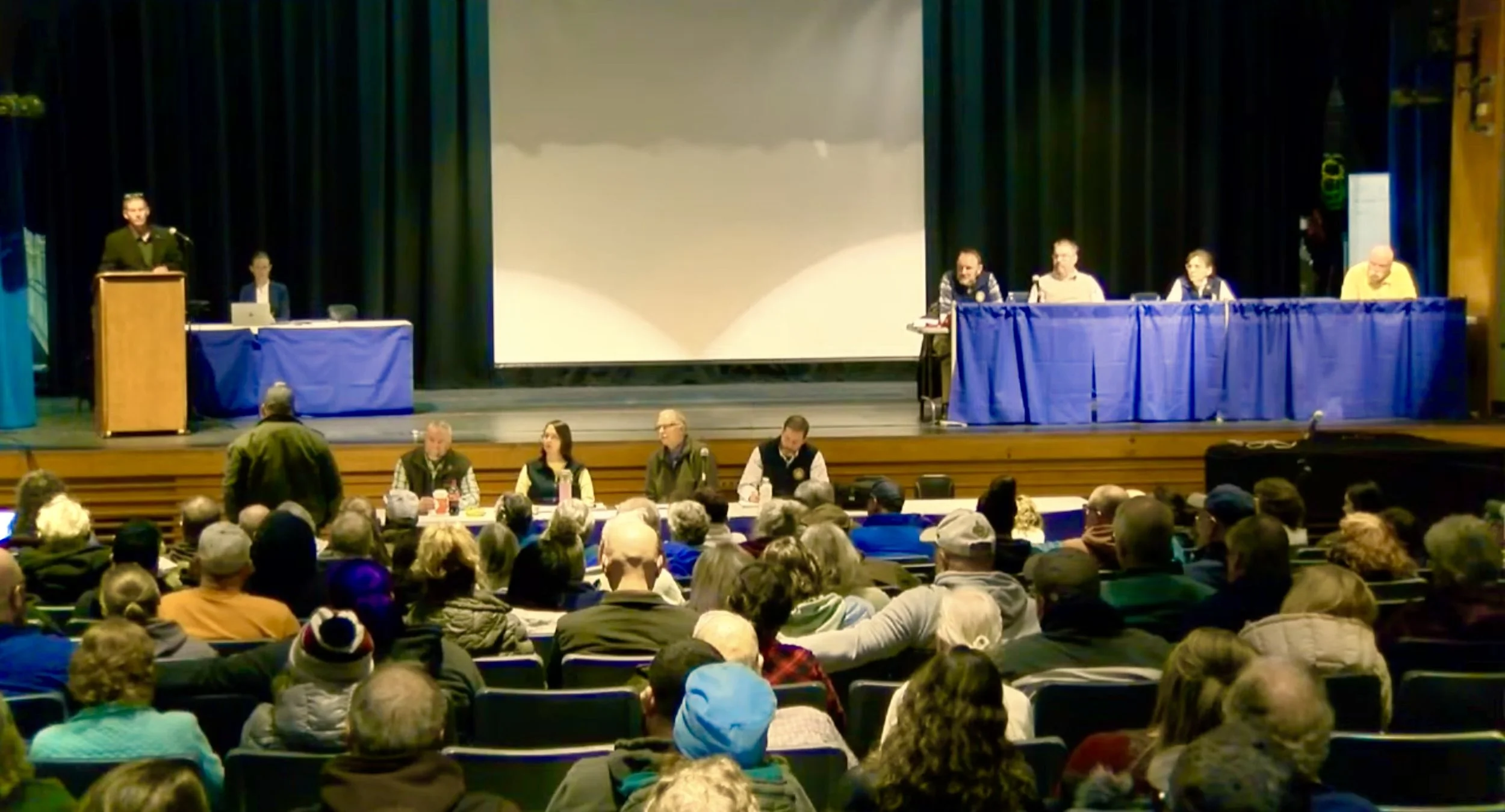
“A gigantic incinerator plant does not belong in a thickly settled village like Baldwinville or anywhere else in Templeton” - Joe Emma, resident. Special Town Meeting, December 5, 2024 Original image courtesy TCTV.

Problems residents face now: #1: Templeton needs more citizen involvement for the town to thrive. Since the 1700’s town government means residents acting on common welfare. What happens in town affects everyone for better or for worse but only a small % of voters attend meetings and make decisions. Solution: Involvement. Take action. Attend meetings, learn about the issues, and vote.
#2: Data Centers: In May, Templeton voters passed a one year Data Center Moratorium. It requires Templeton Development Services to come up with a permanent Data Center bylaw to protect the town. Data Centers can bring in tax revenue….but without a bylaw to set limits protecting our resources they can cause serious health, quality of life, and financial impacts. Solution: Urge Select Board to facilitate development a permanent bylaw regulating data centers asap.
• Water protection. A Data Center would use millions of gallons of water, for cooling, from Templeton’s aquifer, a priceless resource for drinking, farming, fish, wildlife, and recreation! Voters must hold Data Centers to strict regulation and oversight of water use and industrial discharge of contaminated water to prevent adverse impacts. TMLWP can’t treat/purify wastewater from a Data Center’s industrial discharge. To treat/purify discharge contaminated with Nitrates, PFAS, Heavy Metals - Chromium, Zinc, Copper, Salts, Biocides (kills all life), and Corrosion Inhibiters require costly upgrades. Data Centers must be made responsible for contamination, to treat their wastewater. Contaminated water cannot be permitted to enter our environment and aquifer, which holds thousands of years of pristine raindrops that can’t be easily replaced. Water is gold.
• Air Pollution: Diesel generators and fuel storage tanks serving them are standard at Data Centers. Diesel combustion is dirty, noisy, and harmful to breath. There’s risk of fuel leaks and fires. Generators are for emergency use, but often unlawfully left running for Data Center convenience. Non emergency use especially must be tightly regulated.
• Noise. Data Centers are noisy. Mega vibrations, traveling long distances; penetrating residents’ quiet enjoyment; life altering nuisance. Decibel levels and other relevant measures must be used to regulate noise.
• Light and Heat: Light pollution is associated with Data Centers. Light, and “Heat islands”, damage local climate, and all life within a wide range. Light must be regulated to prevent nuisance. Impact of release of heat must be mitigated.
• Financial Controls: Data Centers seek to externalize costs to residents. Low water rates, tax breaks, or deals passing on costs to residents for Data Center infrastructure can’t be permitted. Data Centers must pay in full for water, to treat contaminated wastewater, and for their own infrastructure needs. Data Centers can hijack small town resources, leaving piles of toxic, foreign-made electronic waste after it wears out in a few years. The town must consider requiring Data Centers to post a decommissioning bond or insurance to restore property to its original state, so residents aren’t stuck with abandoned contaminants. Data Center equipment operates under extreme heat; its lifespan is limited.
• Transparency: public, pre-approval disclosure is required. Zoning, building, and fire regulations must be in place in advance to set performance standards for caps on water use, discharge, decontamination, grid impact assessments, noise levels, heat, setbacks, light, and emergency response. Is more fire/EMS equipment, staff, and training needed? Data Center must pay. Clean business, clean jobs, are the better choice. All residents need to get involved now in whatever way they can. It will save heartaches to act before it’s too late.
• Conclusion: Data Centers pose new dangers requiring new protections of health, neighborhoods, financial integrity, and quality of life. They can’t be allowed to release contamination, burden the town, or walk away leaving toxic waste. What worked in the past: people talked with neighbors and town officials, got together, signed petitions, and voted at meetings. It’s time for urgent action for town officials and residents. Clean business and clean jobs are needed, not polluters that take away rather than add value to Templeton’s future.
When Casella sought to put in a landfill on our aquifer, about 850 voters at town meeting overflowed the auditorium into the cafeteria and gym and shut down the land fill.Residents who cared came out strong in opposition. In 2004 the Narragansett Regional Middle School auditorium roughly 850 voters overflowed into the gym and cafeteria to fight a landfill. Voters also strongly opposed plastic incineration for four town meetings. That kind of involvement is needed again right now.
• A Data Center bylaw was recently approved for Mansfield Massachusetts. (Click text for PDF) zoning regulation. Essentially, Mansfield did most of the work; Templeton can adapt this bylaw, which will save time and money. Also found on Mansfield’s bylaws site: Article 23 https://www.mansfieldma.com/DocumentCenter/View/13822/Final-Annual-Town-Meeting-Warrant-2026
Links for this section: AG Review: https://www.mass.gov/municipal-law-review. Permanent regs: https://www.foodandwaterwatch.org/2026/03/04/the-top-10-reasons-data-centers-must-be-stopped/. Water protections: https://share.transistor.fm/s/8c58db06. Regulation & Oversight: https://www.reddit.com/r/interestingasfuck/comments/1sj052s/a_wellarticulated_argument_against_a_new_data/?solution=0ef61d4479b278cb0ef61d4479b278cb&js_challenge=1&token=7afd7253fec22262ff1c52b1703fe9ec3bf54aa42b58ae530e449fc8eb26a403&jsc_orig_r=. Diesel generators:https://prometheus.org/2026/03/10/the-data-center-boom-is-a-diesel-generator-boom/. Diesel Combustion:https://environmentamerica.org/center/resources/false-emergencies-real-pollution/. Emergency Generator use: https://computelaw.blog/real-estate/air-permits-ai-data-center-backup-generators/. Noise: https://www.wxyz.com/news/voices/neighbors-say-noise-from-michigan-data-center-is-24-7-and-upending-their-lives. General Health Risks: https://www.environmentalhealthproject.org/post/the-dangers-of-data-centers. Templeton Vs. Casella: https://www.facebook.com/people/Casella-Waste-Systems-and-Templeton-MA/100079530352946/. ERIN BROKOVICH https://brockovichdatacenter.com/index.html
#3 Chemical Manufacturing: Plastic to fuel incineration may be defined as “manufacturing” if EPA trashes regulations currently defining it as Solid Waste Management, as has been done by 16 states. Massachusetts Dept. of Environmental Protection would then no longer regulate this activity as solid waste management. Environmental protections such as The Clean Air Act would then not apply to “manufacturers” burning plastic to make fuel. Solution: Demand town enact a bylaw banning plastic incineration for the purpose of making fuel.
Clean Seas has been planning to site a Waste Plastic Incinerator at 24 Holman Street for years. When Templeton residents found out, they strongly opposed this! At May 2024 Town Meeting, Voters rejected a zoning article brought forward by the select and the planning boards that would have encouraged this nightmare project - which involved burning 100’s of tons of waste plastic every day to make toxic fuel. See old home page under Resources tab.
According to this excerpt from an email posted publicly by Clean Seas Vice President John Yonce, the Clean Seas Waste Plastic Incinerator project is still planned for Templeton:
“We understand that some people are spreading a false narrative: that Clean-Seas was stopped from opening in Massachusetts before starting development in WV. I thought it might be helpful if I shared some independently verifiable information that disproves this narrative—
Clean-Seas has considered MA as a possible Plastic Conversion Network location for many years, and we announced it and other PCN pipeline projects in MI, AZ, and PR. We haven't yet progressed beyond exploratory conversations with the state DEP and a few potential site partners; our energy is laser-focused on WV.
But our MA project is very much alive: ...
I believe this misinformation may spring from early 2022, when our feedstock partner MacVallee invited us to look at a site they owned in Baldwinville (a village of Templeton) in Central MA. We visited that site once, but otherwise took no steps to develop it (it's a Superfund site -- an old furniture factory.) Our publicized interest may have helped our partners lease that property to a utility, which they did after our visit.
Please note that MacVallee is our feedstock partner for Clean-Seas West Virginia. Although based in MA, they will source feedstock for us from the entire Eastern Seaboard. We expect the feedstock for Clean-Seas West Virginia to come from within WV as well as neighboring states. (It is not economical to ship feedstock long distances, not to mention the carbon footprint.)
Suffice it to say that while WV wasn't the first place we explored for a PCN facility, it quickly moved to the front of our project pipeline simply because the state offered such a strong welcome. We expect it to be the first of 4-5 PCN facilities in North America, and many more worldwide.“
John Yonce
SVP Strategic Development”
Notice Mr. Yonce refers to a “Plastic Conversion Network, PCN, facility” in Templeton. This is consistent with his previous statements - see this article for example: https://www.clean-seas.com/post/clean-seas-inks-agreement-to-establish-second-planned-u-s-plastics-conversion-facility . Facilities owned by others, and in other states, such as W.R. Grace in Maryland, continue to push forward in their efforts to “convert” plastic. Cedar Creek and River Hill, Maryland, thickly settled communities like Templeton and Winchendon, are opposing W.R. Grace’s experimental facility the multinational company says uses catalysts to “convert”, recycle, plastic. W. R. Grace will not reveal what the catalysts are. See the article: https://prismreports.org/2026/08/31/maryland-community-pushes-for-answers-about-plastic-recycling-plant/ . The Bottom line? Waste plastic has thousands of potentially toxic chemicals. The plastic industry’s drive to convince everyone that these plastics can be “converted” or “recycled” without causing any harm is not believable. On the other hand, it’s easy to follow the money in this scheme and see that if plastic industries are permitted operate waste plastic plants, they then get to continue making obscenely large amounts of new plastic - a very profitable business - while making even more pollution from plastic and microplastics.
The Ohio River Valley Institute has been supporting residents of Belle, West Virginia who oppose the Clean Seas Wast Plastic Incinerator that has been built in their town. https://ohiorivervalleyinstitute.org/statement-on-air-permit-approval-for-clean-seas-plastics-pyrolysis-plant/N
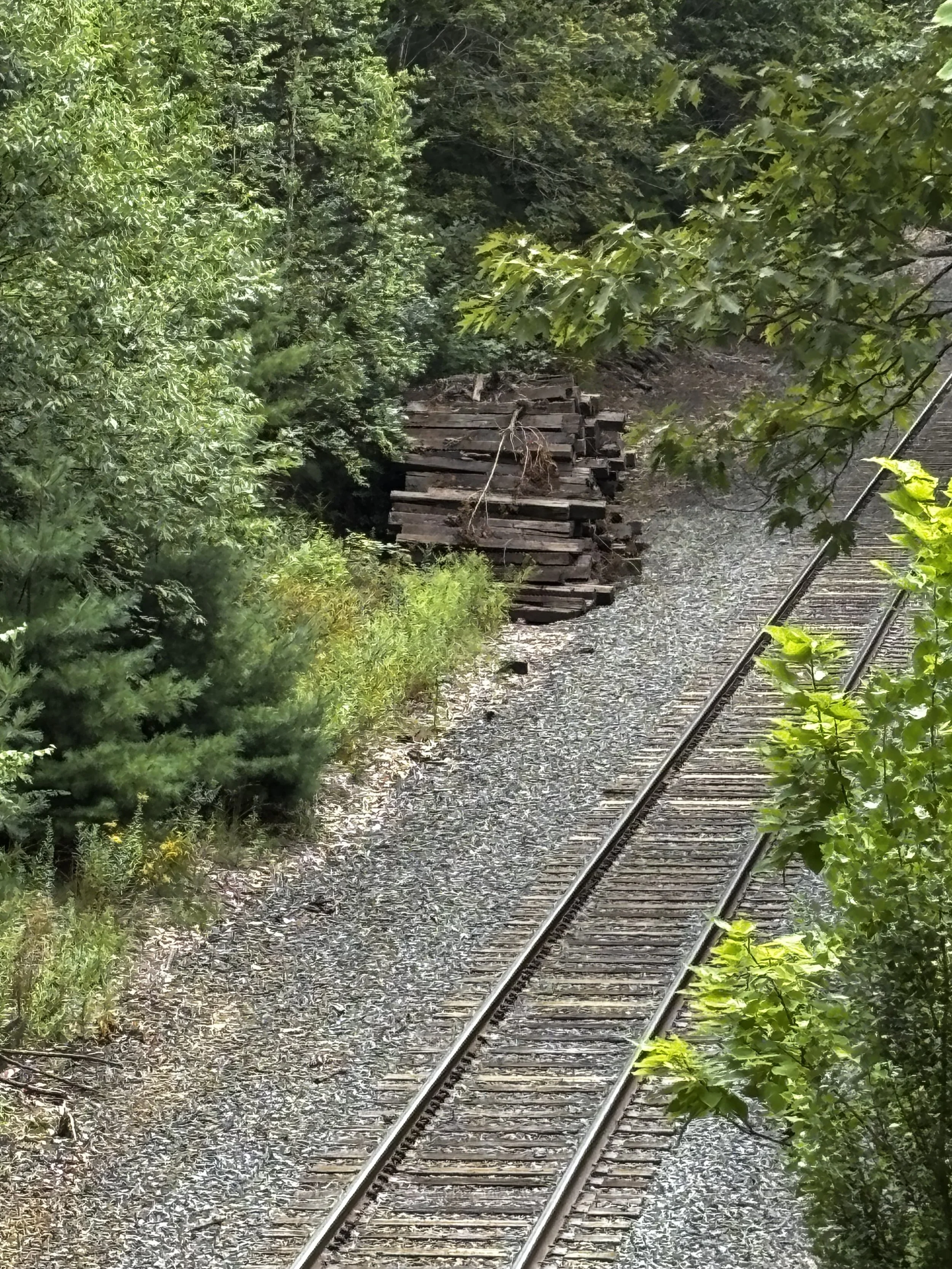
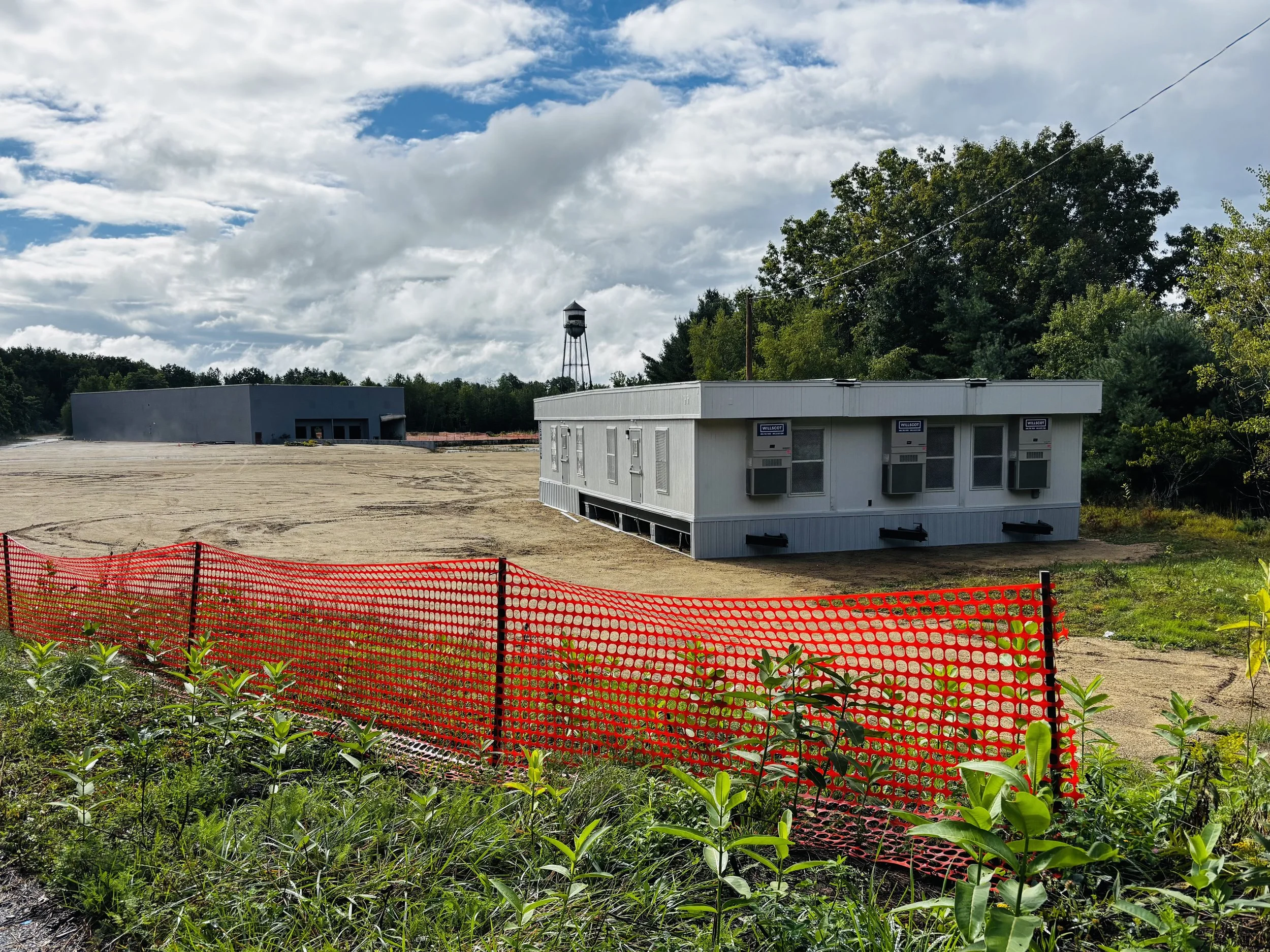
Here is a recent photo taken from the Route 202 RR overpass at 24 Holman Street. The old RR ties piled up next to the track look like they are from the old siding at that location. There was a switch and a siding there put in by Temple Stuart Furniture long ago. It allowed freight cars full of lumber to be unloaded inside the warehouse structure that still stands nearby on the property. Are there any rail nerds out there who can explain this activity? Because it sure seems like something that would only be done if a new siding was being installed. And that would tend to imply heavy industry. Another question…does anyone know why a National Grid Transmission Storage Yard would need a triple wide construction office trailer?